
I’m Leonardo Losoviz from Argentina, but I have lived in Kuala Lumpur, Malaysia, since 2012. Indeed, I’ve been in Asia since 2007, when I started a backpacking trip for 1 year, and that turned out to stretch far longer than expected, including 5 years spent in China.
I’m fully settled in Asia by now, and (as much as possible) I go back to Argentina to visit my family once every year or two.
I have a bachelor’s degree in Computer Science from the University of Buenos Aires, Argentina, and a master’s degree in Teaching Chinese language from the University of Jilin, China.
The Journey Began
During my computer science studies, I learnt to program using several programming languages, such as C and Java. Switching to PHP felt only natural.
I learnt about WordPress in 2012 when a friend of mine needed help fixing something on his non-profit’s site: a setting that didn’t take effect. (The issue was that the WordPress template printed a hardcoded string, instead of taking the value from the setting; it was left like that by the developer who created the site 🤦♂️ )
When exploring WordPress, I was blown away by its emphasis on the user experience, on how it makes it easy for users to create a site without the need to know how to code. Mind you, I’m a developer, so I’m used to writing code. With WordPress, I experienced for the first time creating and updating a site directly from the user interface.
WordPress was not the first CMS I worked with (I had worked with OpenCMS in 2010), but it was the first CMS which I thought could be regarded as the “operating system of the web”.
The Need for “Gato Plugins”

Gato Plugins Logo
Gato Plugins is a venture to offer really useful WordPress plugins, directly aimed at the end user of the website (not only website admins, but also content writers, marketers, etc).
Before launching Gato Plugins, I had created Gato GraphQL, a plugin which allows executing tasks to accomplish pretty much anything (duplicate posts, insert blocks in bulk, translate content, send emails, etc) on the WordPress site, via GraphQL queries.
As I came to find out, Gato GraphQL can be quite technical for non-developers. That’s why I launched Gato Plugins to offer plugins that solve a specific use case via a simple user interface, removing all complexity. All Gato plugins run Gato GraphQL under the hood, but the user does not need to be aware of this.
The first plugin I launched is Gato AI Translations for Polylang, to translate all content on the site (posts, tags, categories, menus, and user descriptions) using AI.
It is different from the rest in that it extracts the exact piece of data that must be translated, from wherever it is located (Gutenberg blocks, Elementor widgets, Bricks elements), and translates only that, without breaking anything.
Other solutions translate the whole content, which can break things: translating CSS classnames may break the layout, modifying a page builder’s JSON format could render a page non-editable, and others.
If everything goes well, in 2026, I expect to launch 2 more Gato plugins.
My worst experience happened just a few weeks ago: I had been using LemonSqueezy as my e-commerce provider. Their service has been working erratically lately, and their team has completely stopped fixing their issues. Several days ago, their server failed when customers attempted to purchase my plugin, so I missed those sales.
I had to rush to replace them. To avoid anything like this happening ever again, my new e-commerce provider is based on my own WordPress site (I should’ve done this from the beginning!)
The moment I am most proud of is when Gato AI Translations for Polylang became operational, as it barely took 1 month to create that plugin (normally, it’d take many, many months). I had spent several years designing an extensible and fully customizable framework for Gato GraphQL, and Gato AI Translations made use of it. When the time came, that effort paid off.
Myself with my Brilliant Team
I’m a one-person team at the time.

Advice for Business Owners
Selling plugins is tough. Just creating an excellent plugin does not equate to having a successful venture. You will also need a solid marketing strategy, or not many people will find out about it.
I had assumed that listing a freemium version of a plugin on the wp.org plugin directory would be enough to generate traffic and get new users. No, it has not proven to be enough.
Now I’m working on generating traffic from other channels (improving my SEO, experimenting with YouTube), but I’m not the best at it. I do not even have any social media presence (I don’t use social media myself).
So my advice is: Try to engage people to help you in those areas you can’t handle (as, in my case, marketing and social media).
Stay in Touch
WordPress & Beyond
Improve traffic to my site to get new customers and launch new plugins.
Everything is changing so rapidly right now due to AI, that it is very difficult to foresee what will happen in 1 year, let alone 5 years 🤷
But if I have to guess: WordPress will be the dominant CMS when collaboration among team members is needed (i.e. when multiple people are needed to edit a post), as AI-created websites won’t provide those functions.
Then, WordPress in 5 years will look not very dissimilar to WordPress nowadays.
Yes. The biggest threat is from AI, from customers not engaging agencies/developers anymore to build their sites, as they can do it all by themselves using AI.
My Love for the WordPress Community
I attend all WordCamp Asia events, and all my local ones: WordCamp Malaysia and WordCamp Kuala Lumpur.
Whenever I have something to share, I apply to be a speaker. I’ve been a speaker in 10 WordCamp events so far, and many meetups too. I’ve recently been accepted as a speaker for WordCamp Asia 2026 in Mumbai, where I’ll share my knowledge on translating WordPress sites.
WordCamps, particularly the regional ones (US, Europe, Asia), are a great opportunity to meet folks working in all areas of WordPress. It’s very pleasant to meet the same people over the years and get to learn how we are all doing.
My fellow folks living in Malaysia who work with WordPress, as well as plugin developers attempting to sell their plugins and make a living out of it.
Because of our shared backgrounds and similar challenges, I greatly appreciate talking to them and learning from them.
How I Keep Myself Updated
My main sources are: Post Status, the Dynamic WordPress Facebook group, The Repository newsletter, and Nathan Wrigley’s podcasts (WPBuilds and WP Tavern Jukebox).
I Have a Life Other Than the Work
One of the reasons I love living in Kuala Lumpur is that there is a forest right in the middle of the city, some 5 minutes’ walking distance from my house.
I believe that we need to make the most out of every place where we live. If you live in Argentina, go learn tango. In China, go do tai chi. Living 5 minutes away from a forest, I go mountain biking every single time I have some free time.

I attempt to stay fit and healthy, doing yoga and cross-training. And I keep my work-life balance as part of my daily routine: I do not work more than needed, try to go to bed early and get up early, and do not engage with my mobile phone (no doom scrolling). I am so boring!
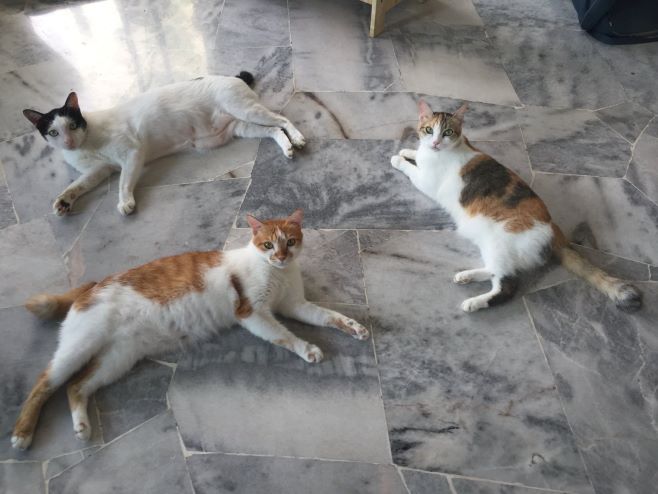
3 cats: Spot, Suki, and Uno.
I Reward Myself by
I really like my work. Doing what I like doing is already my reward. And then, I go mountain biking whenever I’m not working. So all in all, I feel very happy with where I am.
My biggest concern is making a living out of my own venture. That’s why, whenever I get an email notifying me of a new sale, I get an absolute sense of satisfaction. That delivers more than any possible reward I could give myself.